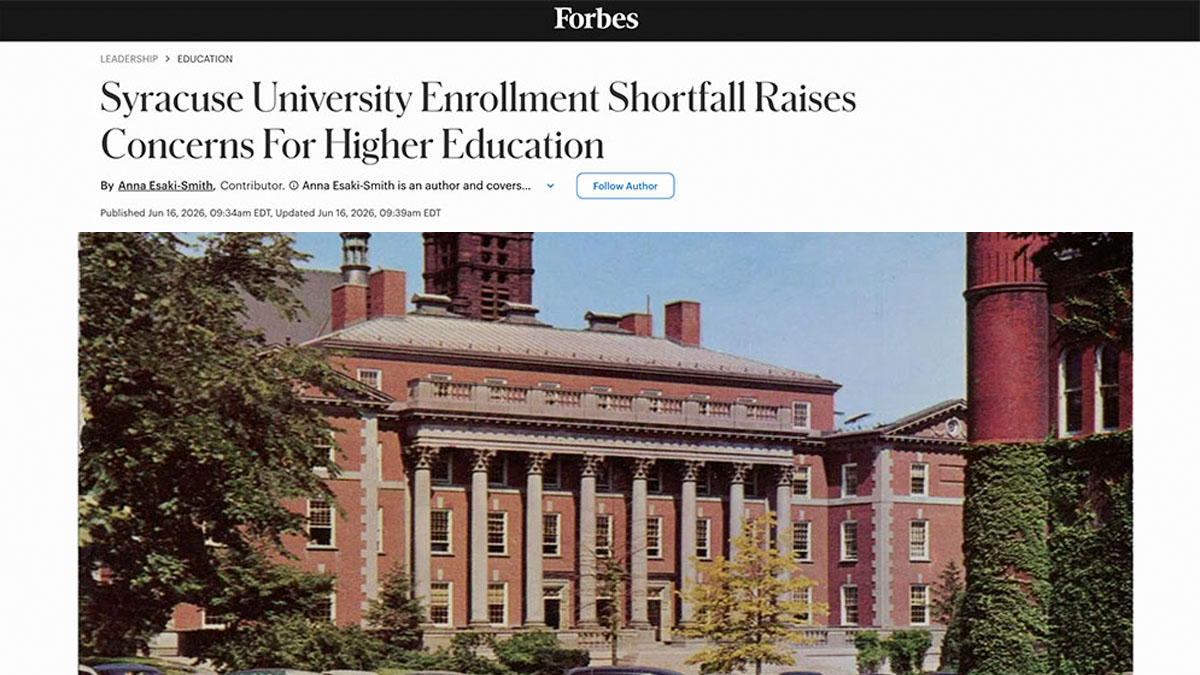
With Syracuse being in the news as of late, colleagues, students, and parents have reached out, sharing article after article and asking the same question: “What is going on over at Syracuse?”
With Chancellor Mike Haynie’s recent announcements — the university missing its enrollment targets, a grim financial outlook — many have wanted to know whether this is a passing problem or a pervasive one. And, quietly, some have wanted to know why I’m no longer there.
I remain grateful for the chance to have taught at Syracuse. Working with those students was among the most meaningful work of my career.
But I think the honest answer to that question — and the more useful one — is that my departure was just a small example of something larger. The challenges the university faces today are not only about demographics, politics, or technology. They are also about internal choices — who gets listened to, whose ideas are considered, and what happens when the people willing to imagine a different future are not considered. My story is not the point. It’s just a confirmation of that belief.
⁂
During my tenure I served as a digital specialist, an assistant teaching professor, and chair of the college’s Diversity, Equity, and Inclusion Committee. In those roles I took on thorny issues from staff, faculty, and students alike. And beneath the surface there was always a quiet truth: a certain subset of people did not feel supported. Students were sold the promise of inclusion and then left on their own to figure out how to build community. Among employees, the work of adapting and modernizing was pushed off from faculty onto staff, breeding resentment. Attempts to bring change forward were met with resistance, isolation, and silence.
I sat in a faculty meeting once and watched the room try to nominate someone to the DEI committee. No one raised a hand. Eventually someone nominated a colleague who wasn’t present — the nomination passed to laughter. “You see, this is what happens when you miss a meeting.”
At the next meeting, that colleague declined. Another round of nominations began. Then it was my turn to say a few words to motivate someone to step forward. I told the assembled faculty: “No. I don’t want to do that. In fact, I was waiting for all of you to finish so that I could make a motion to disband the DEI committee altogether.”
The silence turned quickly to agitation — how could this be permissible, wasn’t this a violation of shared governance? When the chatter died down, I spoke.
{Day after day, I try to make sure students feel seen. I’ve had more students crying in my office than I care to admit — sometimes a student I don’t even teach, who came to me simply because I looked like them. I’ve handed my office keys to students who had no computer of their own and no way to finish an assignment when the labs closed on weekends. I do not believe it should be my job, as the brown person in the room, to convince you to do one of the most important jobs we should be working on at this university?”
You could have heard a pin drop.
Privately, a few texts came in thanking me. Publicly, it earned me a meeting with administration — not about what our collective body had failed to do, but about how I had said it. From there, the atmosphere around me only grew colder.
I kept fielding complaints from students belittled by professors for how they spoke. I kept trying to encourage the ones from the Syracuse community to hold on. One of them said something I haven’t forgotten: “You don’t know what it feels like to sit in conversations where they’re talking about the statistics of your community — the poverty, the lack of education — with every eye in the room fixed on you.” I watched students walk up the hill in the fall and, one by one, walk back down.
⁂
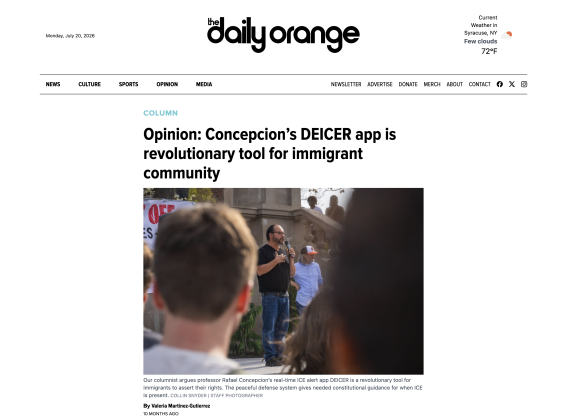
When the current administration turbocharged the use of ICE for deportations, I stood with students. As someone who is Puerto Rican and Mexican, from the South Bronx, who rose from nothing to become the author of sixteen books and a professor, I built an immigrant-rights notification app, DEICER, and encouraged people to share it across the community. I spoke up in faculty meetings when the university moved to strip DEI content from the freshman seminar because students found it “challenging.” How, I asked, do you think the next cohort will read that — arriving to find these issues quietly erased at the very moment this administration is erasing them everywhere else?
I was also, at the time, finishing a contract and had been in talks about applying for a tenure-track position — one that, I was told informally, would combine my background in technology and production with my doctoral research on using AI to close the educational gap in lower-income communities.
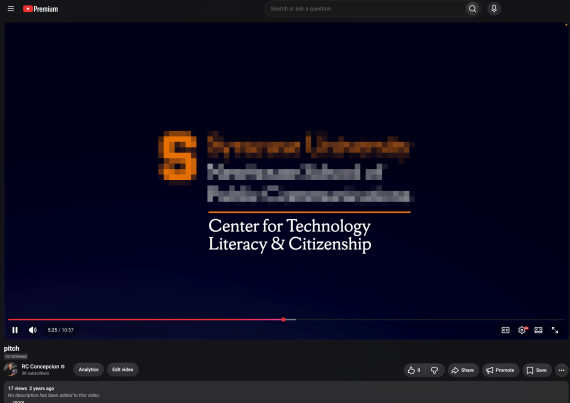
Previously, I had built a twenty-three-point proposal — a slide deck and a video — asking whether we could stand up a Center for Technology, Literacy, and Citizenship: a college-focused, hopefully university-wide hub built around five aims — empowering digital literacy, promoting digital citizenship, bridging the digital divide, supporting academic and career success, and fostering collaboration. It treated AI not as a product to sell but as a tool for asking bigger questions — about ethics, information literacy, and what it means to be a citizen in this new landscape.
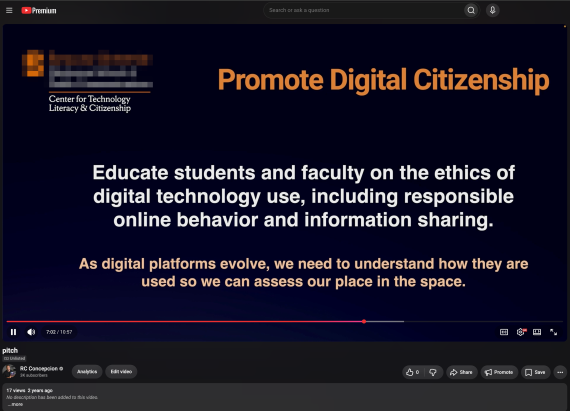
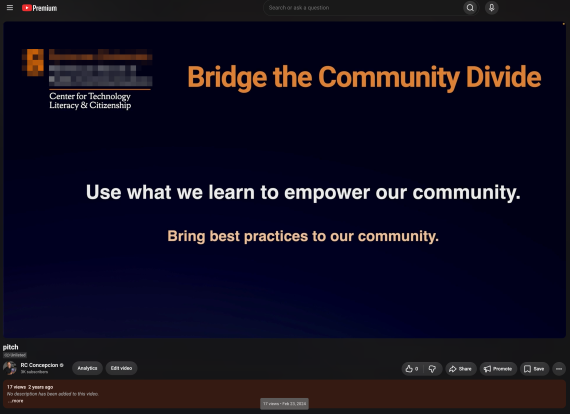
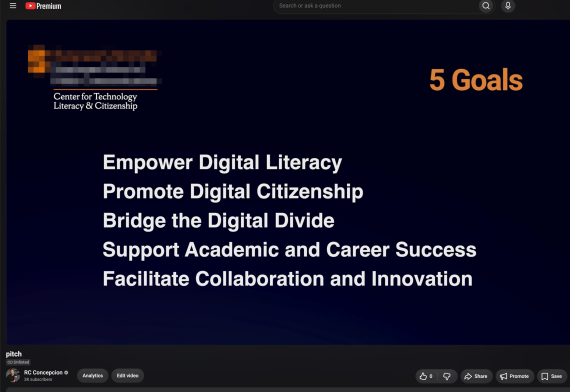
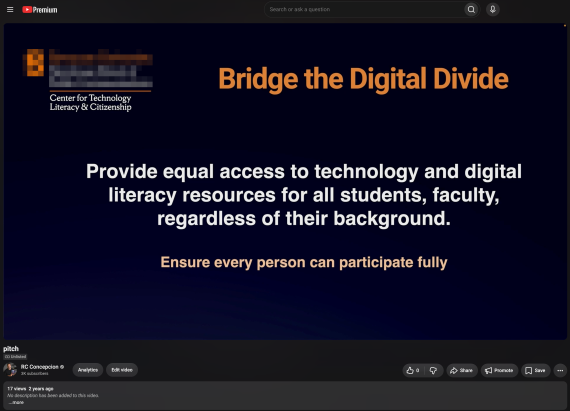
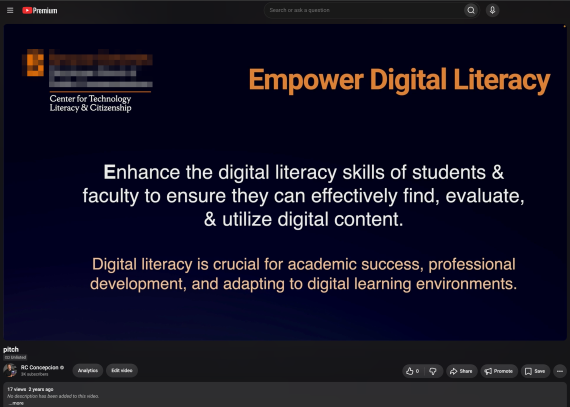
What struck me most was that none of it was a departure from the university’s stated direction. It mapped directly onto the Strategic Plan’s own priorities — emerging technologies, human thriving, experiential learning. And it went where too few AI conversations go: toward equity. One of my students told me flatly, “There’s this assumption that I have a computer, and I don’t.” I was already redesigning an AI curriculum for the Syracuse City schools — helping students who’d only met these tools through the media use them to reimagine their own work, and their own history. It was exactly the kind of imagination the university now says it needs — and I laid it out, on the record, two years before it began publicly asking what it should become. It went nowhere.
The recorded proposal for the Center for Technology, Literacy, and Citizenship
This is the part that is hardest to say plainly. I came to that classroom as a practitioner — someone who had spent decades building things in technology, written sixteen books, and done the work out in the field long before being asked to teach it. I tried to modernize what we were teaching because I had lived the thing we were preparing students for.
Again and again I was pushed into a corner by colleagues who not only lacked the skills to do what we were asking of students — they could not get their heads around the concepts at all.
Imagine what that feels like when you try to find the pattern of who gets to remain, despite qualifications, and who gets silently removed.
I’m sure you’re already thinking the answer in your head.
And yet my curriculum and my content stayed in circulation without me — used to guide and train students after I’d been told I wasn’t qualified to teach there.
That is not a compliment. It is theft.
The ideas were good enough to keep; the person who made them was not.
I think that pattern matters far more than my individual case, because it points to something corrosive. When the people guarding the gate are the ones who cannot implement the bigger ideas, they don’t protect the institution — they protect their own position, and they marginalize the very people with the skills to move things forward. Every time that happens, the organization loses a little more of its capacity to modernize, to adapt, to be flexible in exactly the moments it can least afford to be rigid.
⁂
Three weeks before the end of the semester, I learned my contract would not be renewed. The path I’d been pointed toward had been sunset by the provost’s office. There was no appeal.
What followed I’ll keep brief, because it is not the center of this. I was eventually offered a $32,000 severance in exchange for signing a confidentiality agreement — one that had me resign, waive any claim under Title VI, Title IX, and related statutes, and agree not to criticize the university.
I signed it.
And then, standing outside Newhouse, I felt an overwhelming shame. Here I was, face to face with the First Amendment, trading it for my pieces of silver. I emailed the administration to recall my signature and forgo the payment.
I would rather leave with my integrity — knowing I did my best to defend the communities that look like me — than accept silence.
⁂
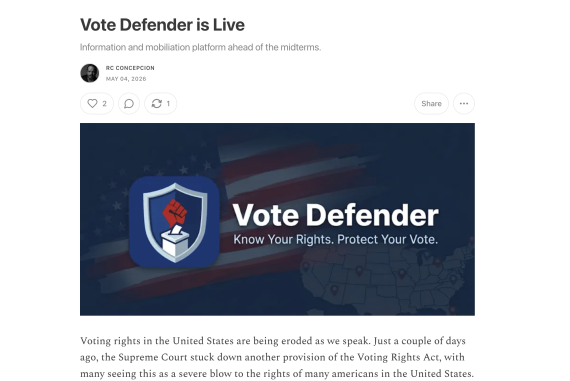
I’ve kept working since, supporting immigrant communities and launching a new app, Vote Defender. But I write this less in sadness than in hope.
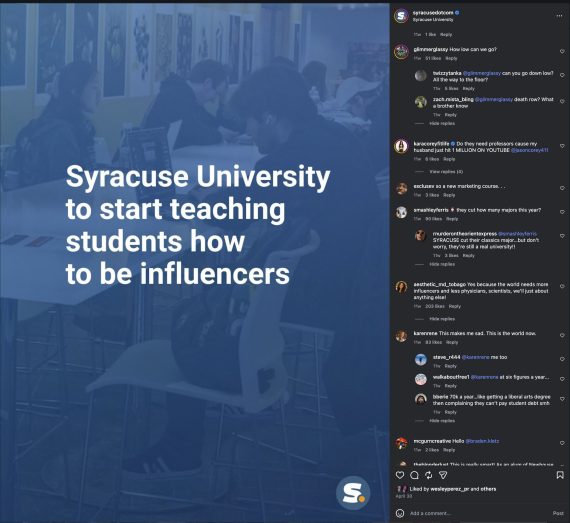
It genuinely pains me to watch what could have been an institute for preparing students to compete and excel in a world reshaped by AI reduced, in the undergraduate imagination, to a $95,000-a-year lesson in “you too can be a YouTube influencer” — the murmur across campus that the place had become “YouTube University,” where the responsibility to teach technology got outsourced to a video feed.
The imagination was there. So were the people. They just weren’t in the room when it counted.
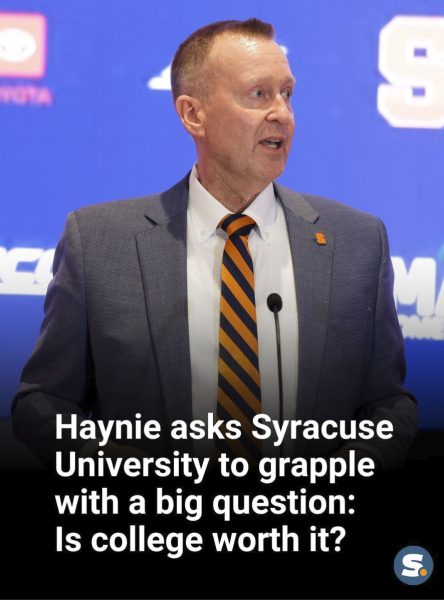
Which brings me back to Chancellor Haynie. From what I’ve seen of his work, I believe he may be up to this task. His willingness to state plainly where the university stands is itself a hopeful sign. My one hope is that the candor is followed by a real reckoning with these structural deficits — and a genuine willingness to listen to the diverse voices still willing to help.
The university is right to ask how it should reinvent itself. The only question that worries me is whether the people capable of answering are still at the table. Time will tell.